

 Suyog Kafle
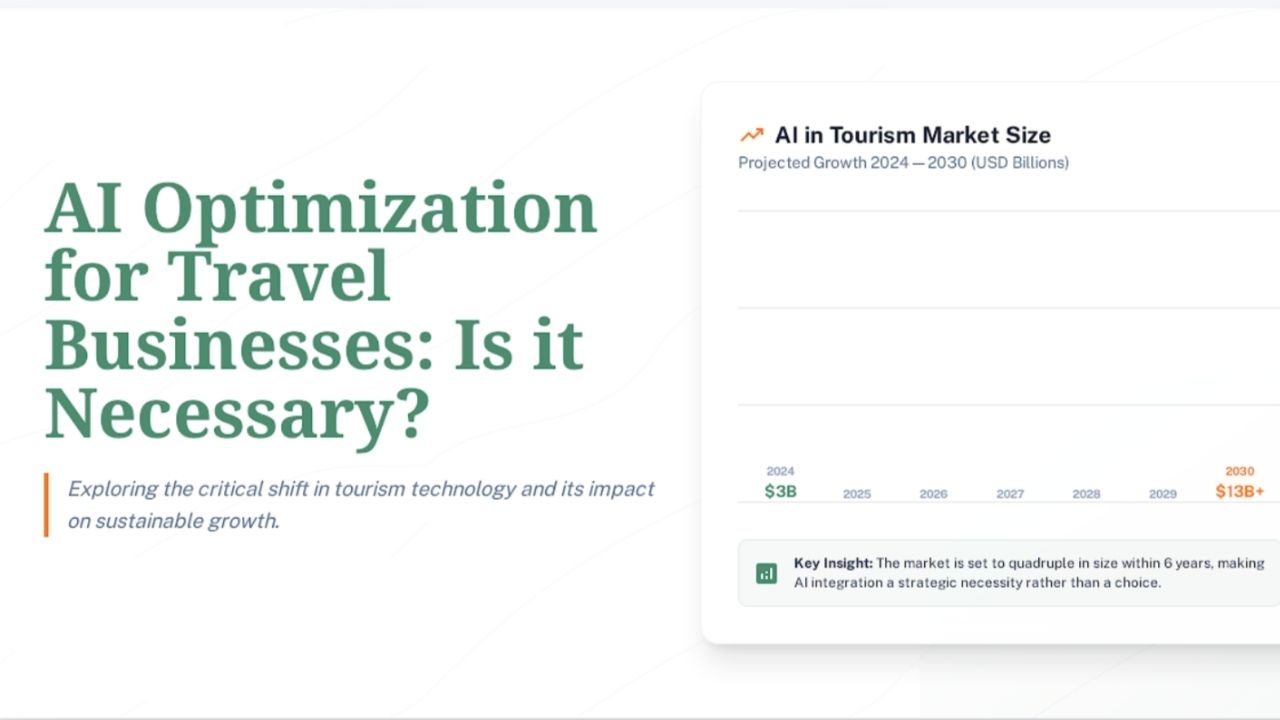
| AI optimization for travel businesses means using artificial intelligence tools to improve how your agency shows up in search, how you handle bookings, and how you serve customers. It covers everything from appearing in ChatGPT answers to using smart pricing tools. The AI market in travel will grow from $2.95 billion in 2024 to $13.38 billion by 2030. Travel businesses using AI now report over 6% more revenue each year. If your travel agency is not set up for AI-driven search yet, you are already losing bookings to competitors who are. This guide shows you exactly what to do. |
Your phone rings. A traveler from Germany found you through ChatGPT. Not Google. ChatGPT. They already have a rough itinerary. They know your prices. And they want to book today.
This is not a future scenario. This is happening right now. And most travel agencies across Europe are not ready for it.
You built your business by showing up in search results. But the rules changed. Today, 60% of all Google searches end without a single click to any website. AI systems answer the question before the traveler ever sees your link.
The good news? You can fix this. And the fix is not complicated. At Nepal SEO, we have worked with over 50 travel brands across Europe, Germany, the UK, and beyond. We have seen what works. This guide gives you the real picture.
| TALK TO OUR TEAM Is your travel website ready for AI search? Talk to our team today and get a free AI visibility check for your travel agency. Visit: nepalseo.com/contact-us/ |
The numbers behind the shift: why AI in travel is no longer optional
Let us start with the market. Not opinion. Numbers.
The AI in tourism market is growing at 28.7% per year. That means it doubles in size roughly every 2.5 years. If you wait another two years to think about this, your competitors will have a head start you cannot close.
| 40% of global travelers now use AI for trip planning Statista 2025 | 3,500% increase in GenAI traffic to travel sites, year-over-year Adobe Digital Insights | 28.7% annual growth of AI in tourism market to 2030 MarketsandMarkets | 381% rise in AI Overviews for travel searches (March 2025) Search Engine Land |
AI IN TOURISM MARKET SIZE (USD BILLION) 2024 TO 2030 Projected Growth
Projected growth at 28.7% CAGR across all travel sector AI applications
| Year | Market Size | Year-on-Year Growth |
| 2024 | $2.95 B | Baseline |
| 2025 | $3.79 B | +28.5% |
| 2026 | $4.88 B | +28.8% |
| 2027 | $6.28 B | +28.7% |
| 2028 | $8.08 B | +28.7% |
| 2029 | $10.39 B | +28.6% |
| 2030 | $13.38 B | +28.8% |
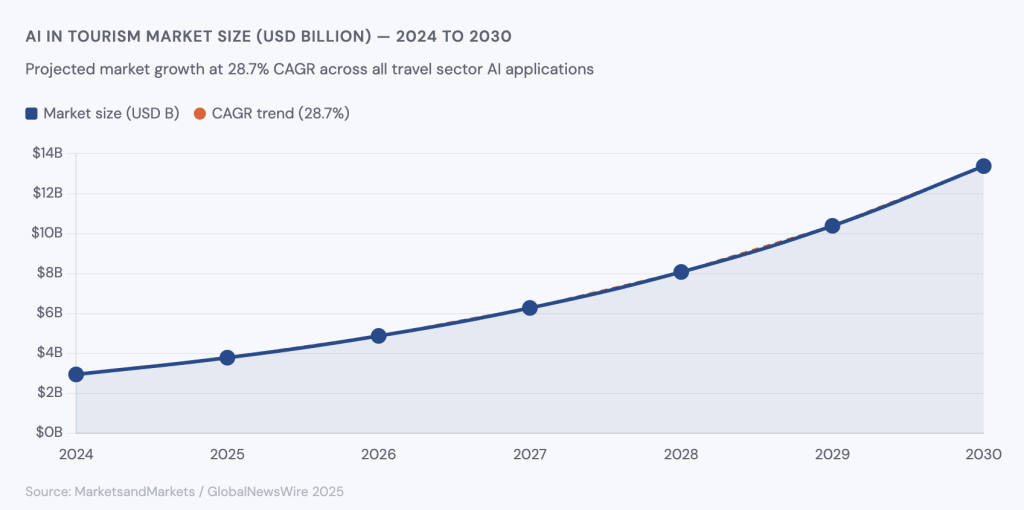
Source: MarketsandMarkets / GlobalNewsWire 2025, AI in Tourism Global Forecast to 2030
These are not small changes. A 381% jump in AI Overviews for travel searches means that when someone in Berlin types “best activity to do in Peru” into Google, they now see an AI-generated answer at the very top. Not your website. An AI summary of your competitors’ content.
But here is what most people miss. Visitors who arrive from AI platforms convert at a much higher rate. They are 4.5 times more valuable than traditional organic visitors. They arrive knowing more. They are ready to book.
What AI optimization for travel businesses actually means
The phrase gets used a lot. But most people cannot tell you what it means in practice. So let us be clear.
AI optimization for travel businesses covers three things. First, making sure AI search tools can find, understand, and recommend your business. Second, using AI tools inside your own operations to save time and make more money. Third, using AI to serve your customers better, faster, and more personally.
It is not just about chatbots. And it is not just about ChatGPT. It covers your Google Business Profile, your content structure, your pricing system, and how your customer service runs.
THE 6 PILLARS OF AI OPTIMIZATION FOR TRAVEL BUSINESSES
| Pillar | What It Means | Why It Matters for You |
| 1. AI-Visible Content | Structured content ChatGPT, Gemini, and Google AI Overviews can read, trust, and cite | Without this, AI tools cannot recommend you even if your content is excellent |
| 2. GEO / LLM Optimization | Getting your agency named inside AI-generated trip plans and itinerary suggestions | More than 50% of travelers now start trip research with an AI tool, not Google |
| 3. Smart Pricing & Demand | AI tools that adjust your tour prices based on live demand, season, and competitor data | Marriott saw 22% more revenue per room using AI pricing small operators can do this too |
| 4. Customer Service AI | Chatbots and AI assistants that handle bookings, FAQs, and follow-ups around the clock | AI chatbots handle 80% of routine inquiries, freeing your team for high-value conversations |
| 5. Personalized Marketing | AI that segments your audience and sends the right message to the right traveler at the right time | AI-driven personalization increases bookings by up to 25% (Mize, 2025) |
| 6. Analytics & Forecasting | Predicting when demand will spike, which packages will sell, and where to spend your budget | Companies using AI for forecasting report over 6% annual revenue growth (McKinsey 2025) |
Most European travel agencies are doing one or two of these. The ones winning in 2026 are doing all six in a connected way. That is what makes the difference.
How travelers in Europe now search for trips
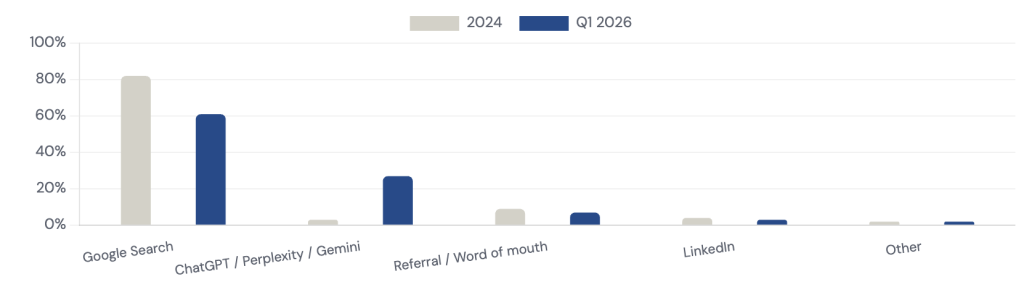
Think about the last time someone in your target market planned a holiday. They did not just Google it. They asked ChatGPT to build an itinerary. They watched a YouTube video. They checked Reddit for honest opinions. Then they came to a website only when they were close to booking.
This is the new travel research pattern. And it is accelerating.
AI ADOPTION IN TRAVEL PLANNING BY AGE GROUP (2025 SURVEY)
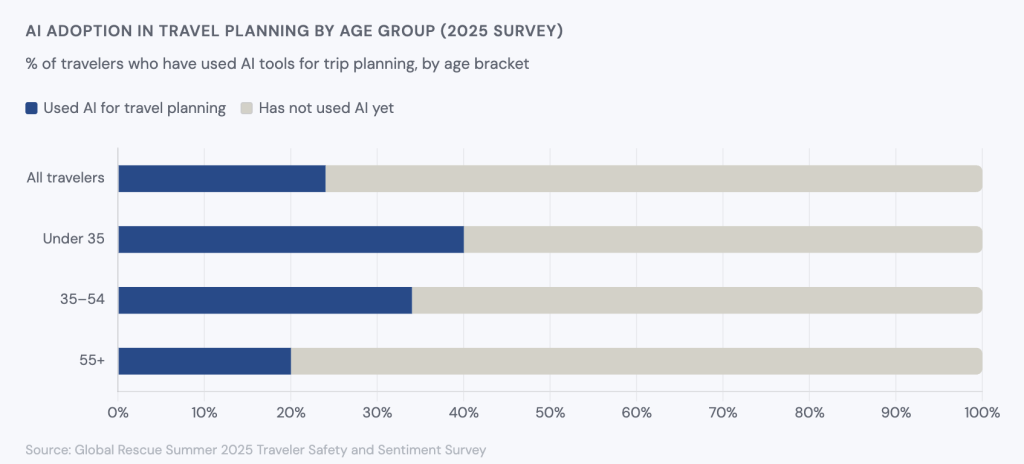
Source: Global Rescue Summer 2025 Traveler Safety and Sentiment Survey
What does this mean for a tour operator in Germany running historical Berlin walking tours? It means your target traveler, a 35-year-old professional from Munich, is very likely using ChatGPT to plan their next adventure. And if ChatGPT does not know your agency exists, you will not get that booking.
Non-US travelers are actually more open to AI than Americans. And they use it more for translation, planning, and booking. That is your European market. These travelers are ready for AI-assisted discovery. You just need to be in the answer.
Your website needs to speak to ChatGPT, not just Google
Old SEO was about keywords. You wrote “Nepal trekking tours” and hoped to rank on Google page one. That still matters. But now you need something more.
Generative Engine Optimization, or GEO, is the practice of structuring your content so that AI systems can confidently cite and recommend you. It is different from keyword SEO. And it is the next frontier for travel agencies.
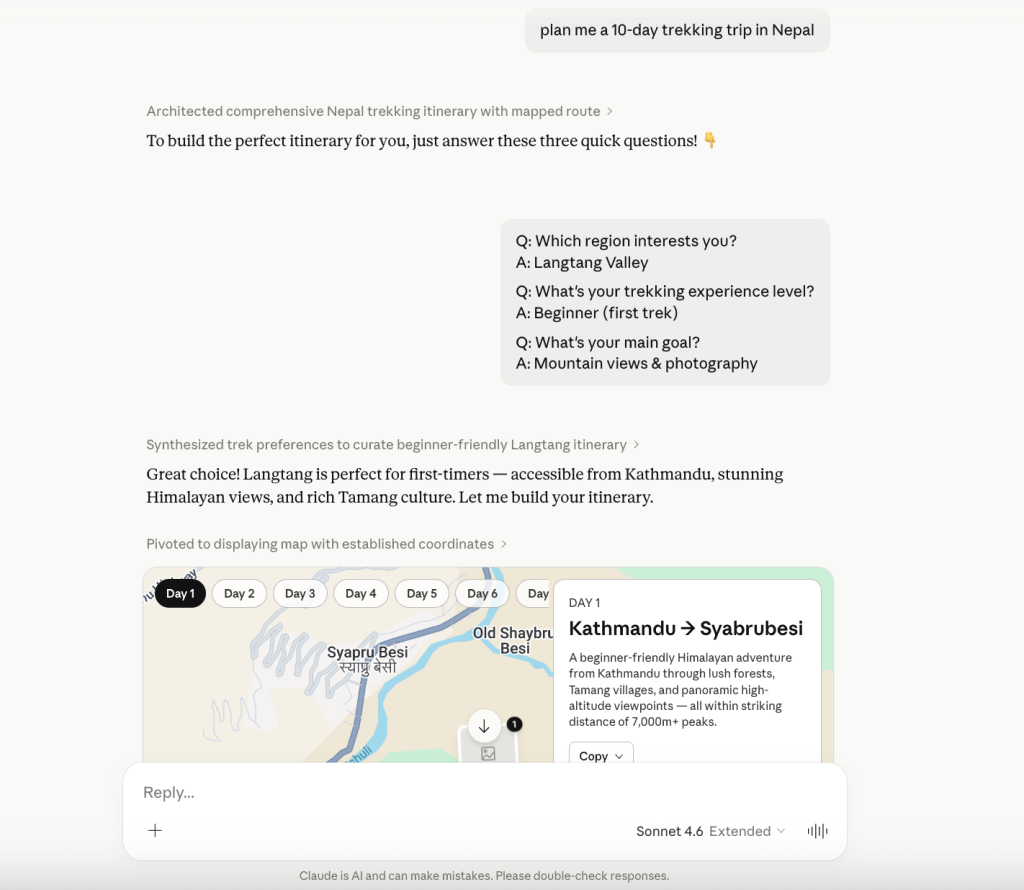
Here is how it works. When someone asks ChatGPT “plan me a 10-day trekking trip in Nepal,” the AI builds a semantic map. It looks for entities it trusts: operators, agencies, destinations, guide certifications. If your business does not appear in the AI’s knowledge base, you do not make the itinerary.
Traditional SEO vs AI Optimization: side-by-side comparison
| Traditional SEO | AI Optimization (GEO + LLM) | |
| Goal | Rank on Google page 1 | Get cited by AI tools and appear in AI-generated answers |
| Content focus | Keyword density and backlinks | Topical authority, structured data, entity recognition |
| Format | Long-form blog posts, metadata | Conversational Q&A, schema markup, FAQ-rich pages |
| Trust signals | Domain authority, backlinks | Reviews, certifications, consistent brand mentions |
| Search behavior | Keyword: “Nepal trekking” | Conversational: “Plan my 2-week Nepal trip for October” |
| Click needed? | Yes, user clicks your link | Often no, AI answers directly from your content |
| ROI timeline | 3 to 6 months typical | Can appear in AI answers within weeks with right structure |
| Bot access | Googlebot only | Must allow GPTBot, ClaudeBot, Google-Extended in robots.txt |
The agencies winning in 2026 do both. They keep their traditional SEO strong. And they layer AI visibility strategy on top. One without the other leaves money on the table.
| At Nepal SEO, we have been doing this for travel brands since 2015. We helped one German travel agency grow their organic traffic by 340% and reach page 1 for 87 keywords in 6 months. The same structured content approach that drove their Google rankings now feeds their AI visibility. The two systems work together. View case studies at: nepalseo.com/case-study |
What this means for European travel agencies specifically
Our clients at Nepal SEO include travel businesses across Germany, the Netherlands, France, the UK, and Scandinavia. We work with agencies selling treks, Southeast Asia tours, African safaris, and European escapes. The AI challenge looks the same across all of them.
European travelers are actually more open to using AI than Americans, with 30% of international travelers reporting AI tool use versus 21% of US travelers. Your market is ahead of the curve. That is a big opportunity if you move now.
And 89% of AI users in travel said they were likely or very likely to use it again. Once your potential customer starts planning with ChatGPT, they will keep doing it. You need to be there every time they ask.
TRAVELER AI PLANNING SATISFACTION, LIKELIHOOD TO USE AGAIN (2025)
| Age Group | Very Likely to Reuse AI | Likely to Reuse AI | Total Satisfied |
| Under 35 | 38% | 51% | 89% |
| 35 to 54 | 36% | 53% | 89% |
| 55 and over | 20% | 60% | 80% |
| Overall | 24% | 65% | 89% |
Source: Global Rescue Summer 2025 Traveler Safety and Sentiment Survey
AI tools For Your Travel Business
You do not need a technical team to use these. Most are plug-and-play. Some connect to your existing booking system. Here is what agencies like yours are using today.
AI TOOLS FOR TRAVEL AGENCIES
| Tool | What It Does for Travel Businesses | Best For | Effort Level |
| Tidio / Intercom AI | Handles customer queries 24/7, qualifies leads, routes bookings to team | Tour operators, hotels | Low |
| Surfer SEO / Clearscope | Writes and scores content so AI tools cite you more often | Content teams, agencies | Medium |
| PriceLabs / RateGain | Adjusts package and accommodation prices using live demand data | Hotels, accommodation operators | Medium |
| SE Ranking AIO Tracker | Tracks whether your content appears inside Google AI Overviews | Travel agencies with SEO focus | Low |
| Jasper.ai / ChatGPT API | Creates destination guides, trip descriptions, and email sequences at scale | Content-heavy travel sites | Medium |
| Schema markup + structured data | Tells AI systems exactly who you are, what you offer, and where you operate | Every travel business, essential | Technical / SEO |
| Mindtrip / Kayak AI integration | Gets your packages visible inside AI trip planners used by travelers | Tour operators, package sellers | Technical |
Trust me on this: the schema markup point is the most important one on this list. It is the technical foundation that allows all the other tools to work. If AI systems cannot read your data structure, they cannot recommend you. This is where most travel agencies have a gap.
AI-powered customer service: chatbots are not enough on their own
Let us be honest about chatbots. A basic chatbot that answers “what is your price for Everest Base Camp trek” is useful. But it is table stakes in 2026.
The real opportunity is in what happens before and after the chatbot interaction. AI chatbots now handle around 80% of customer inquiries on booking platforms. That means your human team spends 80% less time on repetitive questions. And they can focus on the 20% that really need a person.
But the smarter play is using AI to qualify leads. A visitor lands on your Nepal trekking page. An AI asks them two or three questions: when are you traveling, how fit are you, what is your budget. By the time that person hits “talk to our team,” your sales person knows exactly what to offer. Conversion rates go up. Sales cycle goes down.
AI IMPACT ON TRAVEL BUSINESS OPERATIONS — KEY BENCHMARKS
| Metric | Result | Source |
| Customer inquiries handled by AI chatbots | ~80% of routine inquiries | Industry average 2025 |
| Booking increase from AI-driven personalization | Up to 25% more bookings | Mize Research 2025 |
| Companies using AI reporting 6%+ revenue growth | Majority of AI adopters | McKinsey 2025 |
| Travel marketers planning AI personalization investment | 52% by end of 2025 | Sendbird / Statista 2025 |
| Marriott: revenue per room improvement (AI pricing) | +22% in 2025 | Marriott International |
| Hyper-personalization booking lift | +25% | Mize, December 2025 |
There is a difference between a chatbot and an AI assistant that understands your whole catalog, speaks German or French, and remembers what the traveler asked last week. The second type is now affordable for small agencies. The question is who sets it up first: you or your competitor.
Recommended videos: AI in travel (watch on YouTube)
These YouTube searches will find current, useful videos on applying AI in your travel business. Worth 30 minutes of your time.
| Topic | Search This on YouTube | Why It Matters |
| AI for travel agency bookings | “AI for travel agencies 2025 bookings” | Practical case studies on getting more direct bookings using AI tools |
| GEO and AI search visibility | “GEO generative engine optimization travel SEO” | How to appear in ChatGPT travel answers — the most important new skill in 2026 |
| Dynamic pricing for tour operators | “dynamic pricing tour operators AI revenue 2025” | Real operator examples of using AI to improve revenue without increasing costs |
How Nepal SEO helps travel agencies across Europe get AI-ready
We started as a focused Nepal trekking SEO agency. That is where our founder Suyog Kafle built every method we use, helping trekking companies in Kathmandu go from invisible to page one. He trained over 100 SEO professionals and ran seminars across Nepal on exactly this topic.
But our clients needed more. A German agency selling Nepal tours. A Dutch operator running Himalayan packages for European adventurers. A UK-based travel company with a focus on Southeast Asia. They all had the same problem: their websites were not visible to the AI tools their customers were using.
So we expanded. We now work across Europe, handling AI and LLM optimization, on-page SEO, and full search visibility strategy for travel brands. Our clients have seen an average 250% traffic increase and 30% more bookings through our work.
| We have guided 50+ travel brands through SEO and AI visibility strategy. One Nepal trekking company went from zero to 87 page-one rankings and 340% more organic traffic in one year. A European travel agency we worked with saw direct bookings nearly double. These are not estimates. These are results from our case studies, available at nepalseo.com/case-study. |
The agencies we work with are not huge corporations. They are small to mid-sized operators who cannot afford to waste time or budget. That is exactly why AI matters to them. It levels the playing field against Booking.com and Expedia. You cannot outspend the OTAs. But you can out-structure them on AI platforms.
Questions travel business owners ask us about AI
Is AI optimization expensive for small travel agencies?
Not as expensive as you think. Many of the foundational steps, like fixing your schema markup, updating your About page with structured entity data, and making sure AI bots can crawl your site, cost very little. The bigger investment is in content strategy. But even there, you can start with your five best-performing destination pages and build out from there. The ROI is faster than traditional SEO because AI-referred visitors convert at a much higher rate.
My agency already ranks well on Google. Do I still need to care about AI optimization?
Yes. Your Google rankings still matter. But 60% of searches now end without a click. That means even if you are on page one, a large share of potential customers are getting their answer from AI and never visiting your site. GEO and LLM optimization are not a replacement for traditional SEO. They sit on top of it. Think of them as a second layer that captures the traffic you are currently losing.
How long before I see results from AI optimization changes?
Some results are fast. Getting your agency to appear in ChatGPT answers can happen within weeks if your content and schema are correctly structured. Broader visibility improvements follow the same timeline as content SEO, typically three to six months for meaningful movement. The key difference is that AI platforms update more frequently than Google. A well-structured new destination page can appear in AI answers quickly.
Should I use AI to write my travel content?
AI can help you produce content faster. But it cannot replace the kind of specific, experience-based writing that AI tools actually cite. When ChatGPT recommends a trekking agency, it is looking for real expertise signals: guide certifications, specific trail knowledge, client reviews, and original data. AI-generated content that could have come from anywhere does not build this. Use AI as a research and drafting tool. But the voice, the specifics, and the real-world knowledge need to come from your team.
We serve multiple European markets. How do we handle AI optimization for different languages?
This is a real challenge and a big opportunity. AI tools in different markets pull from different source pools. Having well-structured content in German and French, with consistent entity data across languages, dramatically increases your visibility in non-English AI queries. It is more work upfront. But your competitors in those markets are even less prepared for this than in English. It is a gap worth filling fast.
What You Must Understand at End
AI optimization for travel businesses is not a single switch you flip. It is a set of layers you build over time. But you do not have to do everything at once.
Start with the most important step. Test whether AI tools can find and recommend your agency right now. Open ChatGPT. Ask it to recommend a travel agency for the kind of trips you sell. See what comes up. That answer tells you exactly where you stand today.
Then fix the foundation. Make sure AI bots can crawl your site. Add schema markup to your key pages. Structure your destination guides so they answer real traveler questions, not just rank for keywords.
And if you want a team who has done this specifically for travel agencies, with real results to show, we are here. Nepal SEO has been in this business since 2015. We have helped trekking companies, tour operators, and boutique travel brands across Europe and Asia build the kind of search presence that survives algorithm changes and AI shifts alike.
| TALK TO OUR TEAM Your AI visibility check starts here. We work with travel agencies across Europe to build AI-ready websites that show up in ChatGPT, Google AI Overviews, and Perplexity. Free audit. No commitment. See where you stand today. Contact us at: nepalseo.com/contact-us WhatsApp: +977 984-650-3966 |
About Nepal SEO: Nepal SEO is a travel SEO and AI optimization agency based in Nepal, serving travel and tourism businesses across Europe and beyond. Founded by Suyog Kafle, the team specializes in helping tour operators, trekking agencies, and hospitality brands win search visibility and direct bookings. We have served 50+ travel brands.
