

 Suyog Kafle
Why Single Channel Marketing Fails for Travel Businesses
You built strong topical authority for safari keywords. Your blog ranks on page one. Click-through rate looks solid. But your conversion rate is nearly 0.
Here is what is happening in the background. A traveler lands on your page through organic search. They consume your content. Search intent is matched. But before they convert, they perform a branded search query. They want to validate your brand entity across other platforms.
They find your Instagram. Last post: 8 months ago. No user-generated content. No social proof. No behavioral signals that suggest an active business. Trust collapses at the validation touchpoint. They bounce back to the SERP and click the next result.
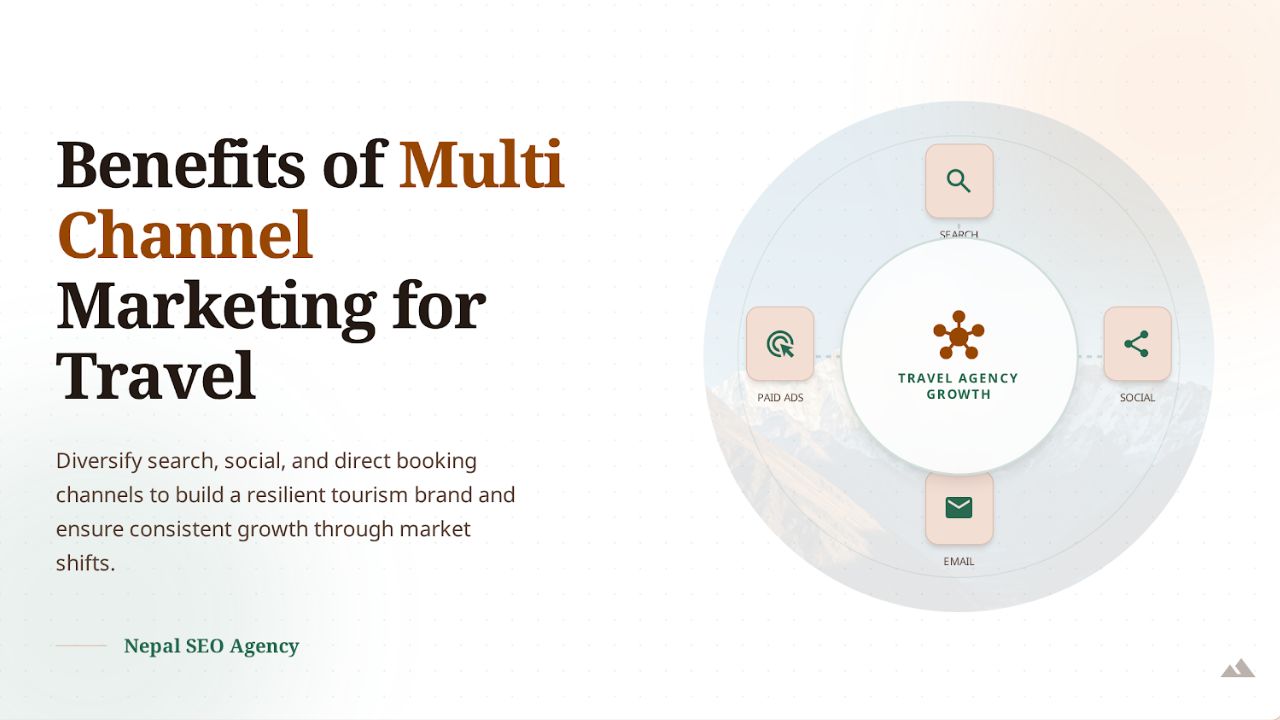
This is single-channel failure. Your organic acquisition funnel works. But without supporting social signals, review authority, and email remarketing sequences, the funnel leaks at every validation checkpoint. Multi channel marketing for travel closes these leaks by building a connected attribution loop where each channel reinforces the others.
How Multi Channel Marketing Matches the Travel Booking Journey
Travel has the most complex customer journey of any consumer. Understanding the attribution path is critical before building any multi channel strategy.
Expedia research shows travelers interact with an average of 38 websites before completing a booking. Sojern’s traveler profiling data found that a single ski trip booking generated 255 digital touchpoints across 4 months. ComScore data puts the average hotel booking cycle at 89 days across 34 sites. And travelers consume 303 minutes of travel content in the 45 days before a transaction.
Here is what a real multi-touchpoint journey looks like for a European traveler booking a safari.
- Touchpoint 1: Informational search query. “Best Kenya safari October.” She clicks an organic result. Reads your destination guide. Search intent satisfied. But no conversion action taken.
- Touchpoint 2: Branded search query. She searches your company name. This is the brand entity validation step. She wants to confirm your business exists beyond one blog post.
- Touchpoint 3: Social signal check. She visits your Instagram. Scrolls your feed. Looks at post frequency, content quality, and user-generated content. She is assessing social proof and behavioral trust indicators.
- Touchpoint 4: Review platform cross-reference. Google Business Profile. Star rating. Review recency and sentiment. Then TripAdvisor. She reads 3 to 4 reviews. This is E-E-A-T validation happening in real time.
- Touchpoint 5: Return visit to website. She browses tour-specific landing pages. Maybe downloads a PDF itinerary. Enters the remarketing pixel pool.
- Touchpoint 6: Retargeting impression. 10 days later, a dynamic remarketing ad appears on her Facebook feed showing the exact safari package she viewed. Brand recall reinforced.
- Touchpoint 7: Email conversion. She subscribed via a lead magnet during touchpoint 5. A segmented email sequence triggers. The third email contains a seasonal offer. She clicks through and completes the booking.
- Seven touchpoints. Five channels. One conversion. In last-click attribution, the email gets full credit. But in multi-touch attribution, every channel contributed. Remove any single channel and the conversion likely does not happen.
This is why multi-channel marketing for travel is not a nice-to-have. It is the only strategy that maps to how travelers actually research and transact.
How Each Digital Marketing Channel Feeds the Next in Travel
The core principle of multi channel marketing for travel is signal compounding. Each channel produces data, behavioral signals, and trust indicators that strengthen every other channel in the system.
This is not about being present on multiple platforms. It is about building a closed-loop system where outputs from one channel become inputs for the next.
How SEO and Social Signals Work Together for Travel Brands
SEO generates the initial discovery touchpoint. Your content matches informational and transactional search intent. You earn organic clicks. But what happens after the click determines whether that traffic converts.
The traveler performs brand entity validation on social platforms. They are looking for recency signals, content consistency, and social proof. Active social profiles generate positive behavioral signals that reinforce brand trust. Dead profiles generate negative signals that increase bounce probability.
But here is the convergence that changed the game in 2025. Since July 10, 2025, Google indexes public Instagram content from business and creator accounts. Posts, Reels, carousels, and profile pages are now crawled and rendered as SERP features in organic search results.
Google treats each Instagram post as an individual indexable URL. Optimized Reels are ranking between positions 2 and 5 on Google SERPs for relevant queries. A travel Reel with keyword-optimized captions, location tags, and alt text competes directly with traditional web pages for the same search real estate.
This means social content is no longer a separate channel from organic search. It is now part of the same SERP ecosystem. Your Instagram Reel for “3 days in the Scottish Highlands” can appear right next to your blog post in Google results. Both drive traffic. Both generate brand impressions. And each one reinforces the other’s topical authority.
The signal loop: SEO drives branded search queries. Branded queries lead to social validation. Social content now feeds back into organic SERPs through indexing. Each cycle strengthens your brand entity’s search presence.
Social Media Drives Email Marketing for Travel Businesses
Social media followers are intent-qualified but not conversion-ready. They have demonstrated interest through follows, likes, saves, and shares. These behavioral signals indicate warm lead status. But converting them requires moving them into an owned channel.
Email is that owned channel. Social platforms are rented distribution. Algorithm changes, reach decay, and platform policy shifts can reduce your social visibility overnight. Your email list is a first-party data asset that no platform can take away.
The acquisition mechanics are straightforward. Instagram bio links to lead magnets. Story CTAs drive newsletter signups. Facebook post CTAs offer downloadable itineraries or travel guides. Each social interaction becomes a micro-conversion opportunity that builds your email database.
The signal loop: Social engagement identifies warm leads. Email captures them as first-party contacts. Email open rates and click-through data feed back into audience segmentation. Segmented data improves ad targeting on social platforms. The loop compounds.
Email Marketing * Bookings
Email marketing generates the highest ROI of any digital channel. For travel businesses, it serves two critical functions: new lead conversion and past-customer rebooking.
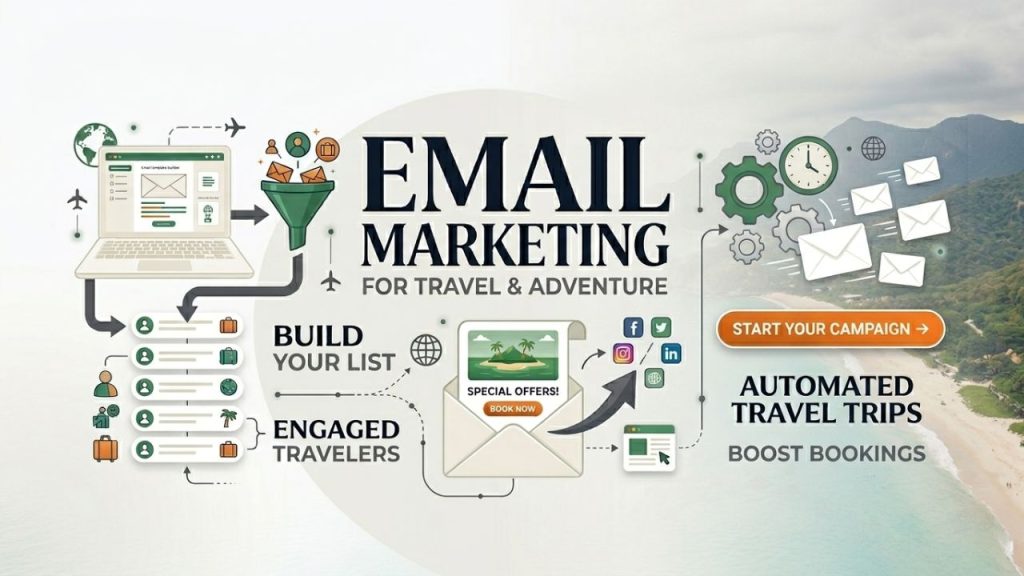
New lead sequences use behavioral triggers. A subscriber who clicked a safari page link gets segmented into the safari interest cohort. Their email sequence delivers content specific to that trip type: itineraries, packing guides, seasonal availability, and pricing. Each email moves them further down the conversion funnel.
Rebooking sequences target past customers with cross-sell and upsell offers. A guest who completed an Annapurna Circuit trek last year receives an email about the Manaslu Circuit this season. The personalization is based on first-party transaction data. No other channel can deliver this level of targeting precision.
Off-season email campaigns maintain brand recall when organic search volume and social engagement drop. They keep your pipeline warm for the next peak booking window.
The signal loop: Email converts leads into customers. Post-trip emails generate review requests. Reviews strengthen E-E-A-T signals in Google. Stronger E-E-A-T improves organic rankings. Higher rankings drive more traffic. More traffic feeds the email list. The loop continues.
Reviews Strengthen Travel SEO and Brand Trust
Google’s quality rater guidelines emphasize Experience, Expertise, Authoritativeness, and Trustworthiness. For travel businesses, review signals are one of the strongest external E-E-A-T indicators.
Google Business Profile reviews directly influence local search ranking factors. Review volume, recency, sentiment, and response rate all contribute to local pack positioning. Businesses with active review profiles get 380% more clicks than those without reviews.
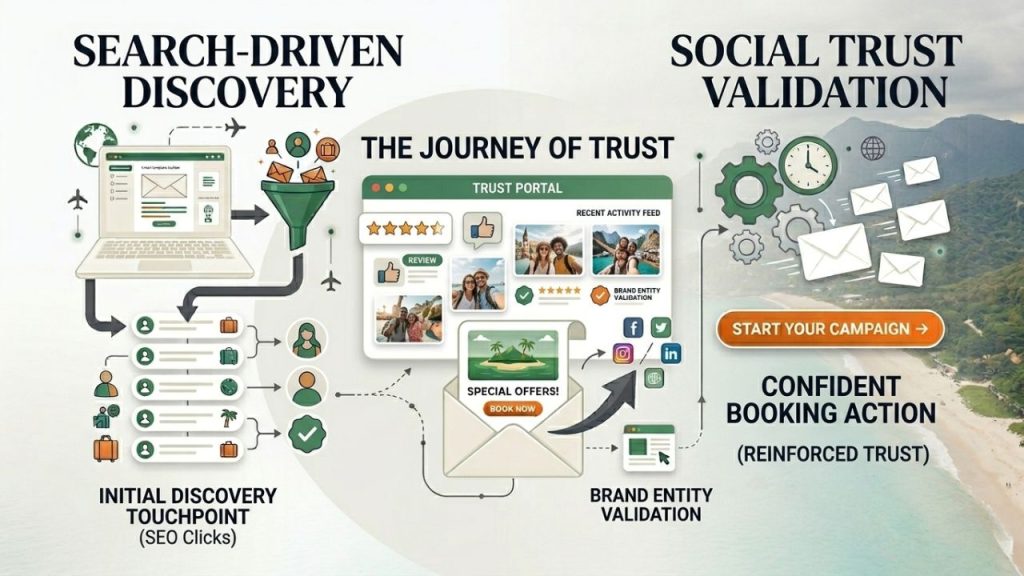
TripAdvisor and third-party review platforms serve as cross-reference validation points. Travelers perform sentiment analysis intuitively. They scan for patterns: consistent praise, genuine language, and recent timestamps. A cluster of positive reviews from the last 3 months signals an active, trustworthy operation. Stale or thin review profiles signal risk.
The signal loop: Quality service delivery generates positive reviews. Reviews improve local SEO rankings and click-through rates. Higher rankings drive more organic traffic. More traffic leads to more bookings. More bookings generate more review opportunities. Each cycle builds cumulative authority.
PPC and Retargeting
Pay-per-click captures high-intent transactional queries. A traveler searching “book Serengeti safari October” has clear purchase intent. PPC positions your tour at the top of the SERP for that query.
But travel has a low first-visit conversion rate. The consideration cycle is too long for single-session transactions. This is where pixel-based retargeting closes the gap.
Your tracking pixel fires on every PPC visitor. Those visitors enter dynamic remarketing audiences segmented by the specific tour pages they viewed. Over the next 14 to 30 days, they see personalized retargeting creatives on Facebook, Instagram, and the Google Display Network. Each impression reinforces brand recall and nudges them back toward conversion.
The signal loop: PPC generates the initial click and pixel data. Retargeting re-engages those visitors across social platforms. Social impressions generate additional brand searches. Brand searches improve organic CTR signals. Improved CTR strengthens organic positioning. The paid and organic channels feed each other.
Content Marketing Powers Every Travel Marketing Channel
Content is the raw material that powers every channel in the loop. And the most efficient multi channel strategy treats content creation as a one-to-many syndication model.
You produce one destination guide: “5 Days in the Masai Mara.” That single content asset is syndicated across the entire channel ecosystem. It becomes the primary SEO landing page targeting informational keywords. It is reformatted as an Instagram carousel with 5 slides covering each day. A 60-second Reel highlights visual moments from the itinerary. The guide becomes an email send to the safari interest segment. Key data points become Facebook ad copy. And the Reel now indexes in Google Search as an additional SERP entry.
One creation event. Six distribution endpoints. Each endpoint generates its own engagement signals that strengthen the others. This is content syndication, not content duplication. Each format is adapted for the platform’s native consumption pattern while maintaining semantic consistency across the brand entity.
Instagram Reels in Google Search
This shift deserves dedicated analysis because it fundamentally changes how social content participates in organic search architecture.
Prior to July 2025, Instagram operated as a walled garden. Content was discoverable only through in-app search, hashtag navigation, and the Explore algorithm. Google could not crawl or index Instagram content at scale.
That changed on July 10, 2025. Meta updated Instagram’s robots.txt directives and removed noindex tags for public professional accounts. Google, Bing, and DuckDuckGo can now crawl and index public Reels, posts, carousels, and profile pages from business and creator accounts.
The SEO implications for travel businesses are significant. Google treats each indexed Instagram post as an individual URL with its own ranking potential. Engagement signals, caption keyword relevance, alt text, and location data all influence how these posts rank. Analysis shows Instagram content most frequently ranks between positions 2 and 5 on Google SERPs.
For visual-first queries common in travel, like “what does the Manaslu Circuit trail look like” or “Zanzibar beach resort experience,” a keyword-optimized Reel can outperform traditional text-based results. Travelers prefer visual content for destination research. A 60-second Reel showing actual trail conditions or resort footage satisfies search intent more effectively than a 2,000-word article for these query types.
To capture this opportunity, travel businesses should treat every Reel like a searchable content asset. Use destination keywords in captions, not just emojis and hashtags. Add descriptive alt text to every image. Tag your geographic location. Maintain consistent posting frequency because Google favors fresh, recent content in its crawl patterns.
Your social media strategy and your Travel SEO strategy are now the same strategy. The channel boundary has collapsed.
Why Travelers Check Your Social Media Before Booking a Tour
There is a specific behavioral pattern in the travel booking funnel that most businesses do not account for in their channel strategy. We call it brand entity validation.
It works like this. A traveler completes an informational search. They find your content through organic results. The content satisfies their query. They are interested. But they do not convert. Instead, they initiate a branded search query.
This branded query is not accidental. It is a deliberate trust verification step. The traveler wants to assess your brand entity across multiple data sources before committing to a high-value transaction. They are performing their own version of E-E-A-T evaluation.
They check your social profiles for recency and activity signals. They scan review platforms for sentiment patterns. They look at your Google Business Profile for rating, review volume, and response behavior. They may check your LinkedIn for team credibility. Each platform is a trust checkpoint.
If any checkpoint fails, like a dormant Instagram profile with no posts for 6 months, the trust evaluation fails. The traveler returns to the SERP and clicks the next organic result. Your SEO investment generated the click. But your weak multi-channel presence lost the conversion.
Travel is a high-consideration, high-value purchase. Nobody books a 3,000 dollar guided tour from a brand that only exists on one channel. Multi channel presence is not about reach. It is about passing every trust checkpoint in the traveler’s validation sequence.
Best Digital Marketing Channels for Travel Businesses
| Channel | Primary Function | Funnel Stage | Signal Type | Cost | Velocity |
| SEO / Content | Organic discovery, topical authority | Awareness, Research | Search relevance, E-E-A-T | Medium | 6 to 12 months / Ongoing |
| Instagram / Reels | Visual trust, SERP features, social proof | Validation, Discovery | Social signals, engagement | Low | Ongoing |
| Lead nurture, conversion, rebooking | Conversion, Retention | First-party data, behavioral triggers | Low | 1 to 3 months | |
| PPC / Google Ads | High-intent capture, seasonal demand | Comparison, Booking | Click data, conversion tracking | High | Immediate |
| Paid Social | Retargeting, lookalike prospecting | Re-engagement | Pixel data, audience signals | Medium | 1 to 4 weeks |
| Google Business Profile | Local SEO, review authority | Research, Booking | Review signals, local ranking | Free | 1 to 3 months |
| WhatsApp / Messenger | Direct communication, post-trip engagement | Booking, Post-trip | Conversational data, review generation | Free | Immediate |
The strongest starting stack for most travel businesses: SEO plus Instagram plus Email. These three form the minimum viable loop. SEO generates organic discovery. Instagram provides visual trust validation and now participates in Google SERPs. Email captures first-party leads and drives conversion. Add PPC and paid social retargeting as the fourth and fifth channels when budget supports it.
How Small Travel Teams Can Run Multi Channel Marketing
Most travel companies operate with small marketing teams. You do not need a dedicated person for each channel. The loop works because content syndicates across channels, not because each channel requires independent content production.
Foundation layer: SEO plus email. Your blog content targets informational and long-tail keywords. Your email system captures traffic through lead magnets and signup forms. This is your acquisition and conversion backbone.
Amplification layer: Instagram. With the July 2025 indexing update, Instagram now functions as both a social engagement platform and a search discovery channel. One Reel optimized with keywords, location tags, and alt text serves double duty.
The content syndication model keeps production manageable. One blog post generates 5 Instagram posts, 1 Reel, 1 email send, and 1 Facebook post. One creation event, six distribution endpoints. The time cost is in creation, not distribution. Distribution can be automated through scheduling tools and email sequences.
Marketing automation handles the mechanical parts. Email drip sequences trigger based on behavioral data. Social posts schedule in advance. PPC bidding runs algorithmically. Your team focuses on content strategy and creative production. The systems handle distribution and retargeting.
If your team lacks the capacity to manage even 3 channels consistently, bring in a specialist travel marketing agency. Nepal SEO Agency runs the full channel loop for travel businesses.
Common Multi Channel Marketing Mistakes Travel Businesses Make
The channel loop breaks when signal handoffs between channels fail. Here are the most common execution failures.
Strong organic rankings with dead social profiles. Your SEO generates branded search queries. But when travelers validate your brand entity on social, they find an inactive account. Conversion probability drops sharply at this trust checkpoint.
Unoptimized Instagram content. Since July 2025, your Reels can index in Google SERPs. But only if captions contain relevant keywords, alt text is populated, and location is tagged. A Reel with emoji-only captions has zero search indexing value.
No first-party data capture. Without an email list, you have no owned channel for lead nurturing, remarketing, or rebooking. Every visitor who leaves without subscribing is a lost remarketing opportunity.
Platform-identical content distribution. Syndicating the same content across channels does not mean posting identical copy. Each platform has native consumption patterns. Blog content, Instagram carousels, email copy, and ad creatives each require format adaptation while maintaining semantic consistency.
Thin review profiles. Reviews are the primary E-E-A-T signal for travel businesses. An empty or unmanaged Google Business Profile, unanswered negative reviews, or a stale TripAdvisor page breaks the trust validation loop.
PPC without retargeting infrastructure. Paying for search clicks without pixel-based remarketing means you capture attention once and lose it. Retargeting converts that single touchpoint into a multi-impression nurture sequence.
Channel siloing. When your SEO contractor, social media manager, and email platform operate independently with no shared data or strategy, the loop does not exist. Cross-channel signal compounding requires integrated planning and shared analytics.
Frequently Asked Questions
What is multi channel marketing for travel businesses?
Multi channel marketing for travel is a connected acquisition system where SEO, social media, email, PPC, and review platforms operate as a closed loop. Each channel generates behavioral signals and trust indicators that strengthen the others. It maps to the complex, multi-touchpoint journey travelers follow before booking.
How do social signals affect SEO for travel websites?
Social signals like engagement, shares, and brand mentions contribute to brand entity recognition in search. Since July 2025, Instagram content is also directly indexed in Google SERPs, creating a direct pathway between social engagement and organic search visibility. Active social profiles strengthen the E-E-A-T signals Google uses to evaluate brand authority.
Do Instagram Reels show up in Google Search results?
Yes. Since July 10, 2025, public Instagram Reels from business and creator accounts are indexed by Google. Optimized Reels with keyword-rich captions, alt text, and location tags rank between positions 2 and 5 on Google SERPs. For visual travel queries, Reels can outperform traditional text-based results.
What is brand entity validation in travel marketing?
Brand entity validation is the behavioral pattern where travelers perform branded search queries after discovering your content through organic search. They cross-reference your brand across social profiles, review platforms, and business listings to verify trustworthiness before committing to a booking. It is essentially the traveler performing their own E-E-A-T evaluation.
How many marketing channels should a small travel business use?
Start with 3 connected channels: SEO for organic discovery, Instagram for visual trust and SERP participation, and email for lead capture and conversion. These form the minimum viable channel loop. Add PPC and paid social retargeting as the fourth and fifth channels when budget supports scaling.
What is cross-channel attribution in travel marketing?
Cross-channel attribution tracks how multiple channels contribute to a single booking. In travel, a conversion might involve 7+ touchpoints across organic search, social media, email, and retargeting ads. Last-click attribution only credits the final channel. Multi-touch attribution models distribute credit proportionally across all contributing channels, giving a more accurate view of each channel’s ROI.
In 2026, with Instagram content indexing in Google, 63% of travelers using generative AI for discovery, and the average booking journey spanning 38 websites across 89 days, operating a single-channel strategy is an unhedged risk.
Nepal SEO Agency has been engineering these cross-channel acquisition loops for trekking operators, safari companies, cultural tour agencies, and adventure travel brands for over a decade. If your channels are operating in silos instead of compounding, get your free channel audit at nepalseo.com today. We will map exactly where your signal loop is broken and how to close it.
